
Solmatlagning tar ett steg framåt i Karagwe
/
Charles Bahati, chef för Mavuno-projekten, och Susanne Hurtig, chef för internationella projekt Ingenjörer utan gränser, undersöker solpanelerna vid Mavunos flickskola.
Bra idéer blir ännu bättre när man utvecklar dem tillsammans. Det är precis vad som händer i Karagwe, där Ingenjörer utan gränser och vår långvariga lokala partner Mavuno Project undersöker hur solenergi kan användas för matlagning i skolor.
Under de senaste två åren har vi genomfört en genomförbarhetsstudie för att ta reda på vilken typ av solkokningsteknik som skulle fungera bäst under de lokala förhållandena. Målet är inte bara att införa ny teknik, utan att hitta en lösning som är tillförlitlig, praktisk och som kan stödja skolor i landsbygdsområden i Tanzania under många år framöver.
Att hitta rätt lösning
Matlagning i skolor kan ske med hjälp av många olika energikällor. Det traditionella sättet att laga mat är med ved och träkol, vilket orsakar föroreningar, avskogning och hälsoproblem. Andra energikällor är flytande petroleumgas (LPG), el, biogas och solenergi. Det finns ingen lösning som passar alla. Vad som fungerar bäst beror på lokala förhållanden, tillgång till bränsle, infrastruktur och långsiktiga kostnader.
På Mavuno Girls Secondary School i Chonyonyo, där man redan har slutat använda träkol och ved för matlagning, har man inriktat sig på att hitta ett system som ytterligare kan förbättra hållbarheten och samtidigt tillhandahålla tillförlitlig energi för tillagningen av de dagliga måltiderna.
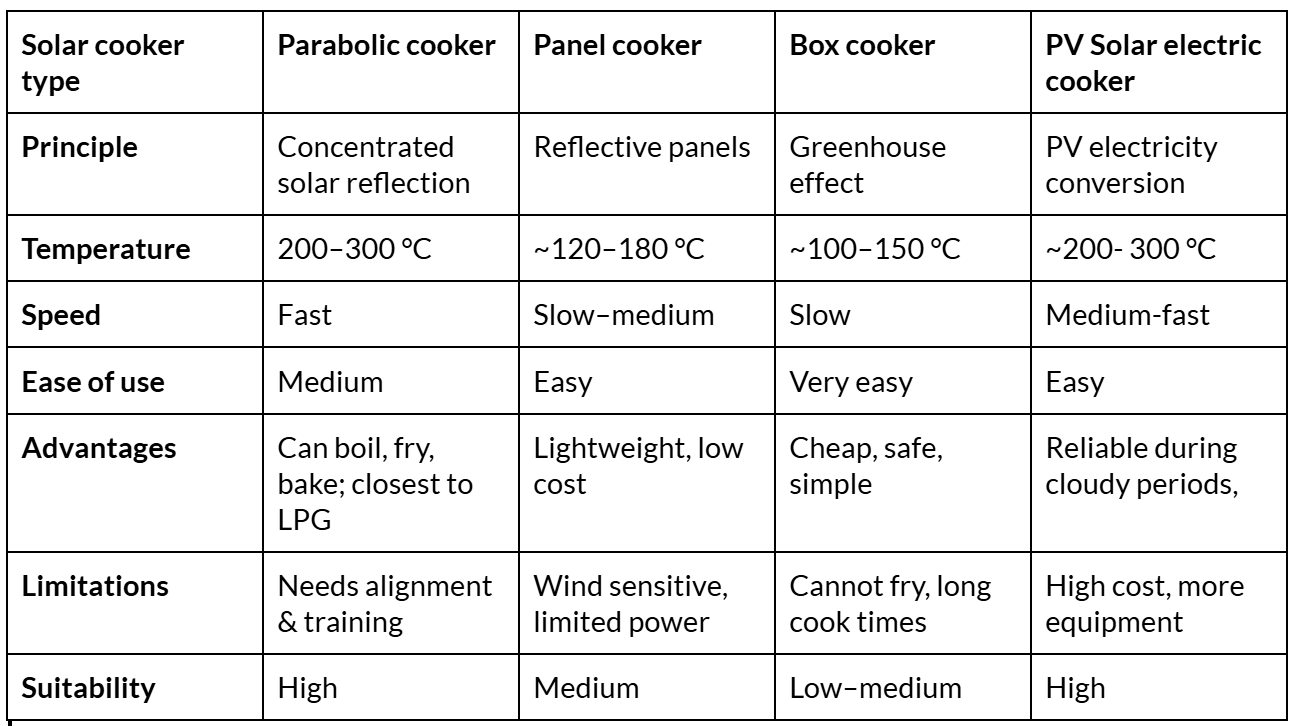
En jämförelse mellan olika lösningar för solmatlagning.
Efter att ha jämfört flera olika tekniker för solmatlagning har solcellsbaserad (PV) solmatlagning visat sig vara det bästa alternativet. Istället för att använda speglar för att koncentrera solljuset genererar systemet el via solpaneler. Elen driver elektriska matlagningsapparater, medan batterier lagrar energi så att matlagningen kan fortsätta även när det är molnigt.
Varför solmatlagning med solceller?
För ett skolkök är tillförlitlighet avgörande. Måltiderna måste tillagas varje dag, oavsett väderförhållandena. Tack vare batterilagringen blir solcellsanläggningen betydligt mer tillförlitlig än många andra lösningar för solmatlagning.
Systemet skapar en renare matlagningsmiljö, minskar luftföroreningarna inomhus och undviker de säkerhetsrisker som är förknippade med koncentrerade solkokare. Även om den initiala investeringen är högre än för enklare solkokare, gör dess tillförlitlighet att det passar väl för institutionella kök.
Precis som all annan teknik har ett solcellssystem sina begränsningar, bland annat vad gäller användningen av batterier och elektroniska komponenter. Trots detta visade genomförbarhetsstudien att det erbjuder den bästa balansen mellan tillförlitlighet, hållbarhet och långsiktig användbarhet.
Förberedelser inför genomförandet
Projektet går nu in i nästa fas. Tillsammans med Mavuno Project granskar vi offerter från olika leverantörer för att hitta utrustning som både passar skolan och som det är realistiskt att skaffa lokalt. Tillgången på komponenter och framtida underhåll är lika viktiga som själva tekniken.
Vi ser med spänning fram emot att detta projekt går från planeringsfasen till genomförandefasen. Om allt går enligt planerna kommer installationen att påbörjas under hösten.
Håll utkik efter kommande uppdateringar!
Håll kontakten

Det bästa sättet att få de senaste nyheterna om våra projekt, evenemang, inspirerande berättelser och möjligheter till volontärarbete är genom vårt månatliga nyhetsbrev.
Det är gratis och du kan avsluta prenumerationen när som helst.
Stöd vårt arbete
När vi förenar våra krafter kan vi – som ingenjörer – göra skillnad för dem som behöver det mest. För bara 200 SEK i månaden under ett år ger du åtta skolbarn daglig tillgång till rent vatten.
Bli en ” månadsgivare ” redan idag.